Three-day gathering draws over 2,000 registrants and engages nearly 90 distinguished speakers, moderators, session chairs, and roundtable leaders across science, technology, education, and public policy
FOR IMMEDIATE RELEASE
August 9, 2026
STANFORD, California
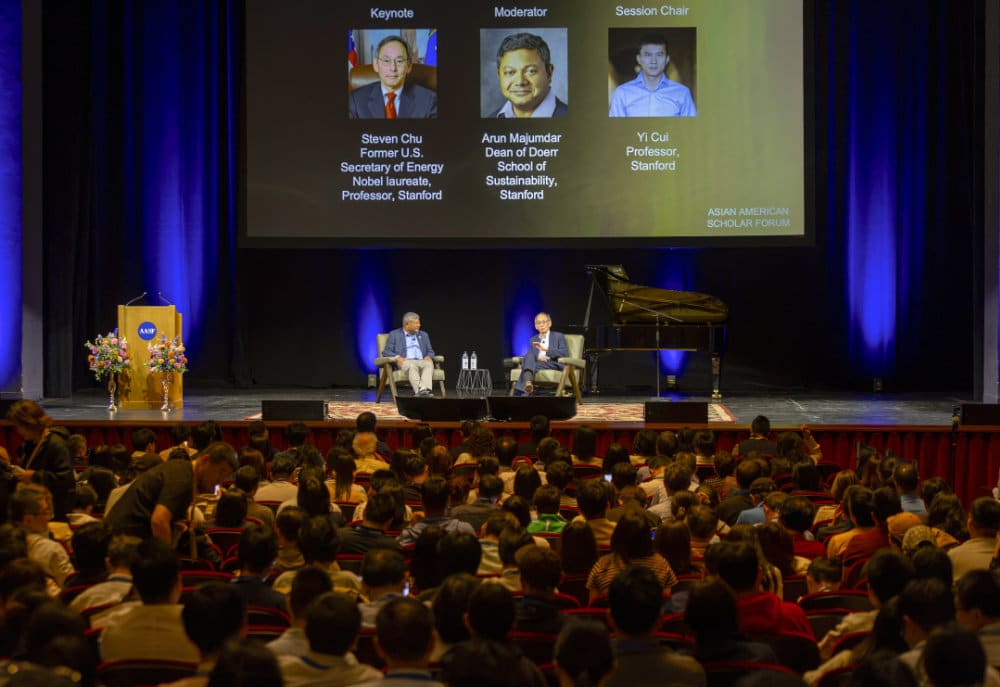
The Asian American Scholar Forum (AASF), in partnership with Stanford University’s Asian American Research Center (AARC), convened the 2026 Frontier & Pioneer Symposium from August 7–9, 2026, at Stanford University.
The three-day gathering drew over 2,000 registrants and engaged nearly 90 distinguished speakers, moderators, session chairs, and roundtable leaders, bringing together leading scientists, engineers, technology leaders, educators, policymakers, entrepreneurs, and researchers. It also marked AASF’s fifth anniversary and its third annual symposium at Stanford, fostering connections across disciplines and communities.
The program opened with the Frontier Symposium on August 7, continued with the Pioneer Symposium & Ceremony on August 8, and concluded on August 9 with a Policy Forum in partnership with the Hoover Institution’s program on the U.S., China, and the World.
Featured speakers included Nobel laureates Steven Chu, Syukuro Manabe, Randy W. Schekman, Samuel C. C. Ting, and Carl Wieman; Fields Medalist Terence Tao; AI pioneers Jeff Dean and Fei-Fei Li; NAE President Tsu-Jae King Liu; 15th NSF Director Sethuraman Panchanathan; former OMB Deputy Director Nani A. Coloretti; Program Co-Chairs Yi Cui and Kai Li; and other leaders from academia, industry, and government.
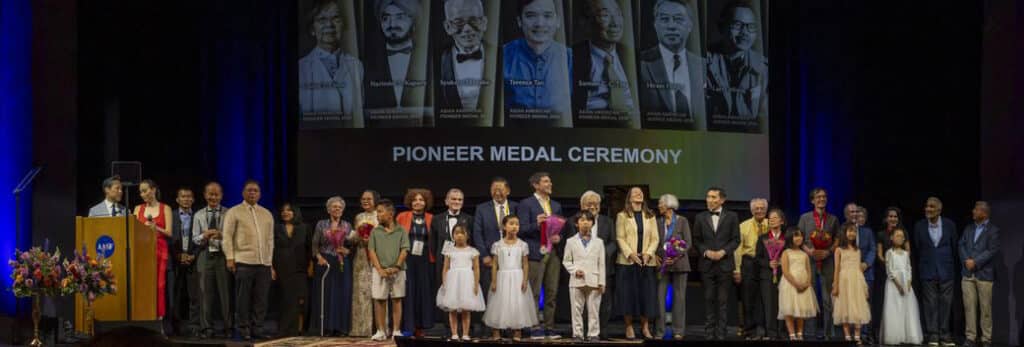
2026 Asian American Pioneer Medal Recipients
AASF presented the 2026 Asian American Pioneer Medal to five leaders whose foundational contributions have reshaped science, technology, and modern life:
- Dr. Louise T. Chow, for discovering RNA splicing, reshaping modern genetics and medicine.
- Dr. Narinder Singh Kapany, for pioneering fiber optics, the backbone of the Internet. Recognized posthumously.
- Dr. Syukuro Manabe, for transforming our understanding of Earth’s climate.
- Professor Terence Tao, for advancing mathematics from prime-number patterns to compressed sensing.
- Professor Samuel C. C. Ting, for discovering the J/ψ particle, revealing the charm quark.
2026 Asian American Justice Medal Recipients
AASF also presented the Asian American Justice Medal to two trailblazers whose leadership expanded representation, opportunity, and rights for generations of Americans:
- Senator Hiram Fong, for being a trailblazer and pioneer in national politics. Recognized posthumously.
- Larry Itliong, for his activism in labor rights and protection. Recognized posthumously.
Key Insights from the Symposium
Across the Frontier and Pioneer Symposium, discussions spanned artificial intelligence, computing, energy, quantum science, the physical and life sciences, engineering, and education, connecting scientific frontiers with the people and ideas shaping the future of research and innovation.
Louise T. Chow, Professor Emerita at the University of Alabama at Birmingham, revisited the discovery of RNA splicing and how it transformed scientists’ understanding of gene expression, while reflecting on a career that later extended into HPV and cancer research.
Nobel laureate Steven Chu discussed progress in battery storage and solar power alongside unresolved challenges including agricultural emissions and the long-term effects of climate change.
Yi Cui, Fortinet Founders Professor at Stanford University and Program Co-Chair of the symposium, highlighted advances in high-energy silicon-anode batteries and long-life nickel-hydrogen storage for the grid and AI data centers, while emphasizing the importance of moving science from the lab to real-world solutions.
Jeff Dean, Founder and CEO of Discovery Loop, made his first public appearance since leaving Google after 27 years, discussing how AI could move beyond answering questions to help initiate, iterate, and increasingly automate experimental processes and accelerate the pace of scientific and engineering discovery.
Chuan He, John T. Wilson Distinguished Service Professor at the University of Chicago, highlighted how reversible RNA modification opened the field of RNA epigenetics and enabled a new approach that increased rice and potato yield and biomass by about 50 percent in field trials.
Liang Jiang, Professor of Molecular Engineering at the University of Chicago, explained how quantum computers could tackle problems beyond the practical reach of classical computing, while highlighting quantum error correction as the central challenge to achieving large-scale, fault-tolerant systems.
Fei-Fei Li, Founder and CEO of World Labs and Sequoia Professor at Stanford University, discussed AI’s evolution beyond language toward spatial and physical intelligence, highlighting the shortage of real-world interaction data as a major bottleneck for robotics and physical AI. She also urged the audience to preserve human agency, stressing that technology should empower human creativity and productivity rather than make decisions on people’s behalf.
Fields Medalist Terence Tao examined how AI is beginning to reshape mathematical research, from serving as a research collaborator to changing how mathematicians approach discovery and verification. He emphasized that as AI becomes increasingly capable of producing mathematical results, the more valuable human skills will be explaining results clearly and recognizing deeper connections between problems.
Nobel laureate Samuel C. C. Ting reflected on five decades of experimental physics, from the discovery of the J/ψ particle to the Alpha Magnetic Spectrometer on the International Space Station, where his team continues to search for clues to dark matter and antimatter.
Amin Vahdat, Senior Vice President and Chief Technologist for AI and Infrastructure at Google, examined the infrastructure required to scale AI, emphasizing that energy and power efficiency have become central constraints on future growth.
Nobel laureate Carl Wieman examined how decades of research on learning and effective teaching can inform science and engineering education as universities integrate AI into the classroom.
Special Research and Mentorship Roundtables
Research and Mentorship Roundtables held over lunch on August 7 and 8 created smaller settings for students, young researchers, and attendees to engage directly with leading scientists, technology executives, university faculty, and AASF Fellows across different fields. They helped connect generations through small-group engagement and mentorship.
Science and Public Policy
The third day’s Policy Forum examined the future of American research and innovation, including federal research funding, civil rights and science, U.S.–China competition, public service, and leadership. Speakers included 15th NSF Director Sethuraman Panchanathan, former OMB Deputy Director Nani A. Coloretti, Congressman Ted Lieu, Congressman Sam Liccardo, former Congressman Mike Honda, Yasheng Huang, Keith Yamamoto, Samuel S.-H. Wang, Gang Chen, Glenn Tiffert, and AASF Executive Director Gisela Kusakawa, among others.
About the Asian American Scholar Forum
The Asian American Scholar Forum (AASF) is a national nonprofit organization dedicated to promoting belonging, freedom, and equality and to elevating the contributions of Asian American scholars, scientists, professionals, and leaders.
AASF works to strengthen America’s research and innovation ecosystem by supporting scholars, advancing public understanding, and preserving the stories of Asian American pioneers whose contributions are an integral part of the broader American story.
For more information, visit www.aasforum.org.