
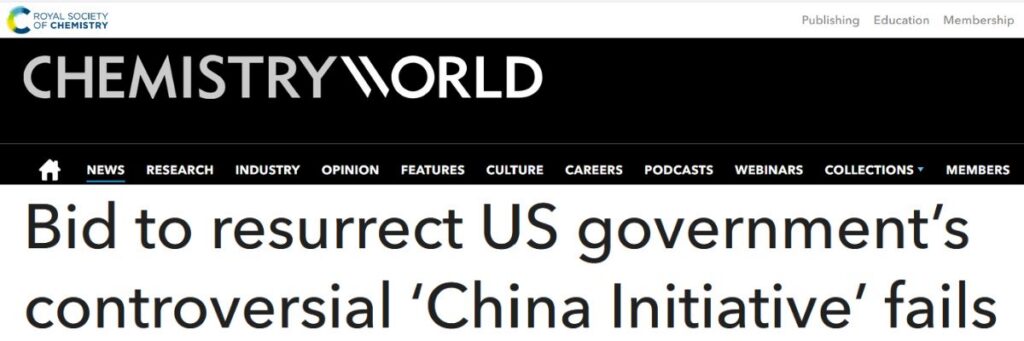
Chemistry World has published national coverage recognizing the Asian American Scholar Forum community’s major contribution to a victory not only for civil rights but also for the U.S. scientific leadership and research community.
On January 23, 2026, the Fiscal Year 2026 Commerce, Justice, Science, and Related Agencies appropriations bill was signed into law, marking the successful removal of language that could have reestablished the Department of Justice’s China Initiative. Chemistry World’s coverage highlights both the policy implications and the human cost of the China Initiative, underscoring why this outcome matters for the future of U.S. research and innovation. Professor Gang Chen, AASF Board Member and Fellow, is at the center of the human side of this dangerous effort to reinstate the China Initiative.
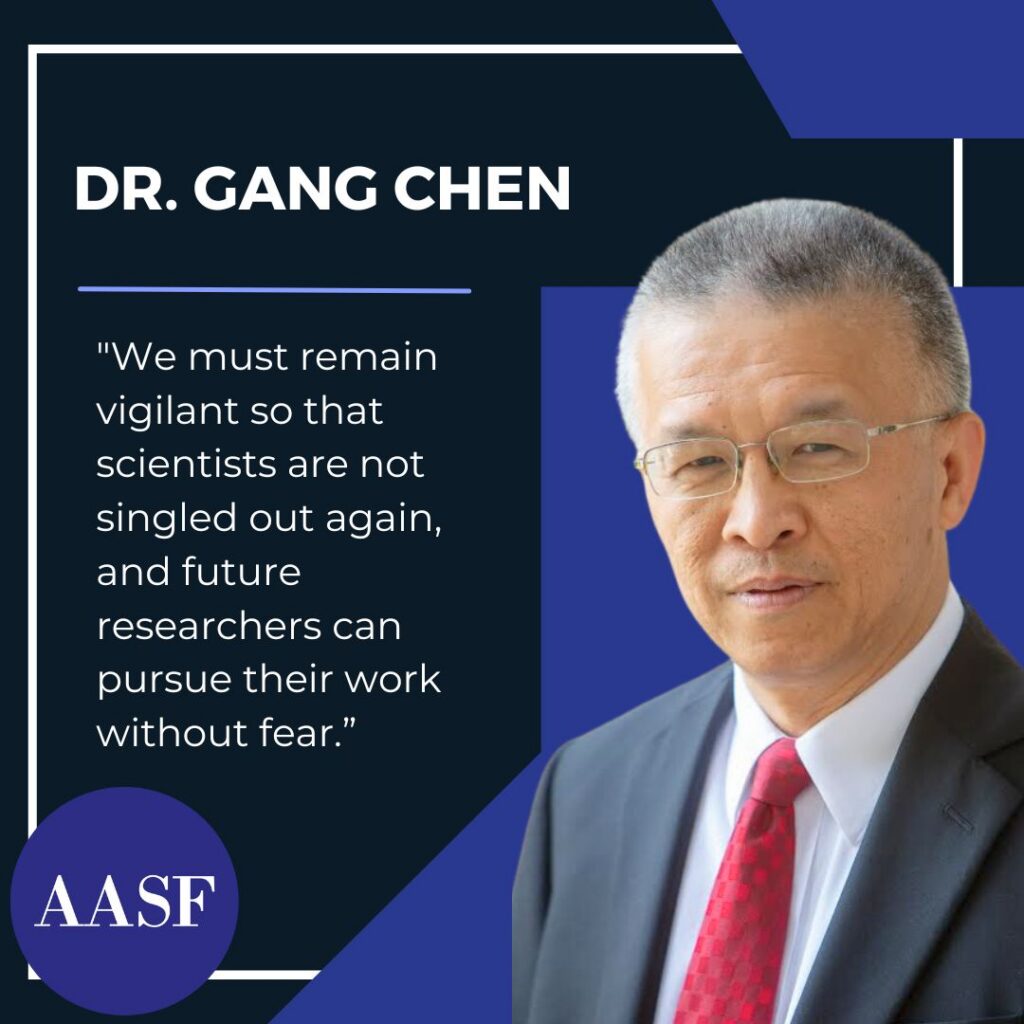
A pioneering nanotechnologist and former head of MIT’s nanoengineering lab, Professor Chen was arrested and prosecuted under the China Initiative in 2021. His case ultimately collapsed and was dismissed, but the experience revealed how deeply flawed policies can ruin lives and undermine trust across the scientific community. Gang was also among more than 1,000 faculty members nationwide who endorsed a public letter opposing efforts to revive the Initiative led by AASF fellows.
“As someone who lived through the human cost of the China Initiative, this outcome matters deeply,” stated Chen. Professor Chen tells Chemistry World that ending efforts to resurrect the China Initiative is “an important step,” but suggests the fight to prevent its return will continue. He urges research universities, funding agencies, and policymakers to “remain vigilant so that scientists are not singled out again, and future researchers can pursue their work without fear.”
This outcome reflects the power of collective action. Thanks to the engagement of the AASF community and allies, including more than 1,000 professors, researchers, scientists, and advocates across the country, Congress heard a clear and consistent message. More than 80 civil rights and advocacy organizations joined this effort, led by AASF and partnering organizations. We are also grateful to the Congressional Asian Pacific American Caucus (CAPAC) for opposing the revival of the China Initiative and for its bicameral letter, endorsed by 24 members of Congress and several organizations, including AASF.
“This is a meaningful victory,” said Asian American Scholar Forum Executive Director Gisela Kusakawa to Chemistry World. “The engagement of our AASF fellows, members, and leadership reinforced a clear message to lawmakers: our country thrives when we uphold American principles of fairness and due process. America’s ability to lead in science and innovation is strengthened when we avoid policies that erode trust and cast suspicion broadly.
This moment belongs to this community. I am deeply grateful to the professors, scientists, and researchers who stepped forward to educate policymakers and make clear what is at stake for U.S. scientific competitiveness. While repeated efforts to revive the China Initiative have surfaced since its termination in 2022, this outcome shows what is possible when our community speaks together with clarity, persistence, and evidence.
Education is at the forefront of our work at AASF. Our scientists, researchers, and scholars speak up for the benefits not of one community, but America as a whole. Thank you for standing with AASF and for helping ensure that the U.S. remains fair, competitive, and welcoming.”
Chemistry World mentions two AASF fellows, Professor Peter Michelson and Professor Steven Kivelson, and their leadership of a faculty letter that was critical in preventing the China Initiative. These AASF fellows reflect on the effort and the widespread concern across the scientific community.
“This decision shows that policymakers can be persuaded when the research community explains the real consequences of past policies,” said Peter F. Michelson, Luke Blossom Professor in the School of Humanities & Sciences, Professor of Physics at Stanford University, and AASF Fellow. “U.S. scientific leadership depends on our ability to attract talent, collaborate internationally, and foster an environment grounded in fairness and trust. Preserving these principles is essential if we want American research institutions to remain credible, competitive, and strong.”
“From the start, it was clear to many of us in the U.S. scientific community that the China Initiative was more harmful than helpful in promoting American science and security,” said Steven Allan Kivelson, Prabhu Goel Family Professor at Stanford Institute for Theoretical Physics, and AASF Fellow. “The wise decision of the present congress not to reinstate this failed approach shows that our government does pay attention to input from the research community, and thus underscores the importance of continued scrutiny and engagement by all of us.”
If you want to make a difference and be notified of the latest policies impacting the research community, become a member of the Asian American Scholar Forum. AASF members are part of a growing national community that drives impact, stays informed, and shapes the policies that directly affect scholars and researchers. The work of protecting belonging, freedom, and equality for all is not won in a single moment. It requires sustained commitment. By becoming a member, you add your voice to a community prepared to stand together, not only for today’s challenges, but for the long road ahead.
Asian American Scholar Forum (AASF) is a national nonprofit that promotes belonging, freedom, and equality for all. In response to heightened anti-Asian sentiments and profiling in the U.S., AASF has been a leading national voice fighting for the rights of Asian American and immigrant scientists, researchers, and scholars. AASF membership includes members from the National Academy of Engineering, the National Academy of Medicine, the National Academy of Science, and the American Academy of Arts & Sciences, in addition to past and current university presidents, provosts, vice provosts, deans, associate deans, and past and current department chairs.